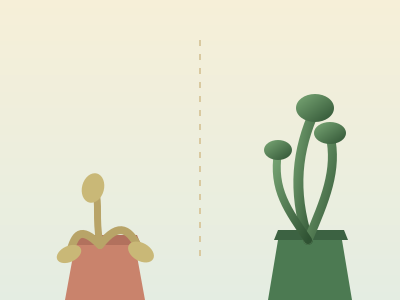
Almost every struggling houseplant traces back to one of a handful of very common, very fixable habits. If something in your collection looks off, run through this list before assuming the plant is simply doomed — chances are it isn't.
1. Watering on a fixed schedule instead of checking the soil
"Water every Sunday" feels reassuring, but plants don't dry out on a calendar — they dry out based on light, season, and pot size. This is the single most common mistake, and it's why overwatering kills more houseplants than underwatering does.
Fix: Check the soil with a finger before every watering, not the day of the week. See our full watering guide for the details.
2. Using a pot with no drainage hole
A pot without a drainage hole means excess water has nowhere to go — it pools at the bottom, the roots sit in it, and root rot follows even if you're "watering correctly" otherwise.
Fix: Plant in a pot with a drainage hole, or keep the plant in its plastic grower's pot and place that inside a decorative pot without one — just make sure to empty any water that collects in the outer pot after watering.
3. Placing a plant based on how it looks in the room, not how much light it needs
It's tempting to put a plant wherever it looks best — a dark hallway, the centre of a coffee table, a windowless bathroom shelf. But every plant has an actual light requirement, and no amount of good intentions substitutes for it.
Fix: Choose the spot based on the plant's needs first, then the plant that fits the spot. If a corner is genuinely dim, pick from plants suited to low light instead of forcing a sun-lover to survive there.
4. Repotting too often, or not at all
Some new owners repot the moment they bring a plant home, disturbing roots that were already settling in. Others never repot at all, leaving a plant root-bound for years in a pot it outgrew long ago — leading to stunted growth and soil that dries out almost instantly.
Fix: Leave a new plant alone for its first few weeks in your home. After that, repot only when you see roots circling the bottom of the pot or growing out of the drainage hole — typically once every one to two years, into a pot just one size larger, not a dramatically bigger one.
5. Ignoring humidity and temperature
Many popular houseplants originate in tropical climates and struggle in the dry air near heaters, air conditioning vents, or drafty windows — even if watering and light are otherwise correct. Crispy leaf edges are often a humidity problem, not a watering one.
Fix: Keep humidity-loving plants away from AC vents and heaters, group plants together (they raise humidity around each other slightly), or mist occasionally. Avoid sudden temperature swings near drafty doors and windows.
Most plant "failures" are really just a mismatch between the plant's needs and its environment — fix the mismatch, and the plant usually recovers on its own.
If a plant is struggling and none of these five quite fit, it's worth checking the roots directly — gently ease the plant out of its pot and look for firm, pale roots (healthy) versus dark, mushy ones (rot). But for the vast majority of indoor plant problems, one of the five habits above is the real culprit.
← Back to all guides